
“Of what use is it that we can travel to the Moon, if we can’t cross the abyss that separates us from ourselves?”
– Thomas Merton-American Monk and writer
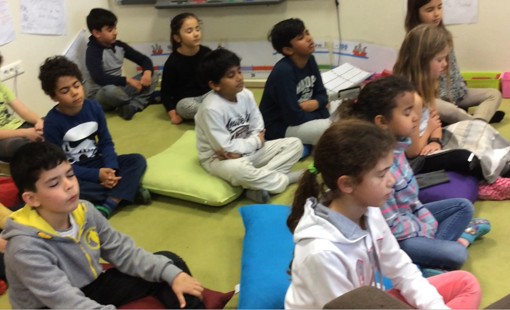
On a daily basis many adults struggle to remain calm and present in the moment multitasking and dealing with increasingly hectic daily routines. As a Primary Learning Support teacher at IICS, I regularly encounter children who also find it hard to focus and pay attention to the present. After conversations with colleagues who had similar observations we decided to try and find some appropriate tools to help ourselves and our students. One of my colleagues suggested mindfulness and immediately I felt drawn to the practice having heard of it before but not being aware of what it actually meant. As a team we then set out to explore mindfulness and how we could incorporate it into our lives and at school.
Research
The first thing we decided to do was to take an online course for adults on Mindfulness by Monash University. We decided to do this as it seems that we needed to initiate mindful practice ourselves before we could start to think about how to implement it at school. This free online course is very practical and takes 3 hours per week over 6 weeks. The course gives a very concise overview of what mindfulness is and the science behind it. There are examples of mindful meditations to practice as well as forums for sharing thoughts and experiences and captivating videos. The guided meditations and the self paced nature of the course make it a worthwhile experience. https://www.futurelearn.com/courses/mindfulness-wellbeing-performance
Practice
Meanwhile we started to look at practical ways that we could implement mindful practice at school. Research presentations by Daniel Goleman gave us ideas for how to practice “belly breathing” with early years children. https://www.youtube.com/watch?v=scqFHGI_nZE
As mindfulness is about directing our attention inwards, working on noticing when you breathe is one way to start working on awareness. We practiced our belly breathing using “breathing buddies”, stuffed animals that we placed on our tummies to observe the movement they made as we exhaled and inhaled deeply concentrating on becoming aware of our breathing.


We also started to trial the Smiling Mind site and free app with our students. http://smilingmind.com.au/my-smiling-mind/
This site is a free sign up and has many guided meditations and activities to work through online. The site allows you to choose the age-group you work with, has audio files to download and shows how you and your students are progressing with a history tab, achievements, personal evaluations etc… Another website we used that has similar mindful practices for children is Go Noodle. This site also has exercises that are designed to help children focus in a fun and hands on way. https://www.gonoodle.com/
Mindfulness is purposefully paying attention, in the present moment, in a non judgemental way. Mindfulness meditation practices are not at all strange rituals but are in fact readily and easily integrated into everyday life.
We therefore decided to incorporate mindful eating, mindful colouring and mindful walks into our practices as good practical ways to focus our attention and open ourselves to sensation and experience.
All of these practices require students to focus on sensations, how things around them look, feel, smell, taste or sound. Mindful listening exercises with a gong or bell were also incorporated into the school day by some teachers.
Impact
Observing the early years students during “breathing buddies” exercises in the initial stages of practice and after the first few weeks demonstrated that children over time were able to sustain focus for longer and progressively extended periods of time from 3 minutes initially building up to 10 minutes.
Furthermore older children were beginning to show a greater understanding of self and started differentiating emotions (what we like/dislike) from feelings (how we respond to our emotions). Many of these children expressed pleasure after the practices and talked about a sense of calm and wellbeing.
Conclusions and next steps….
We have been really excited about the impact of this work on our students and also the high level of interest from our colleagues from all parts of the school. The primary team has already started to implement many of the practices and some of our colleagues have requested that we visit their classes and demonstrate some of the practices to the students.
We continue to find new ways to explore how to practice with children. Blowing bubbles, or making pinwheels for example are fun ways to introduce mindful breathing to young learners. Finally we hope to have a scheduled time each day allocated for mindfulness practice.
As a result of our presentation at the recent CEESA conference, we have been invited to present at an upcoming mindfulness conference in Ljublana, Slovenia.
Further recommended reading and links to organisations
Books by Ellen Langer, a long time proponent of Mindfulness as a vital life skill, inspiring reads both personally and professionally:
Mindfulness – Ellen J langer 1989 (in the Library)
The Power of Mindful Learning Ellen J langer 1997 (in the library)


Leave a Reply
Want to join the discussion?Feel free to contribute!