
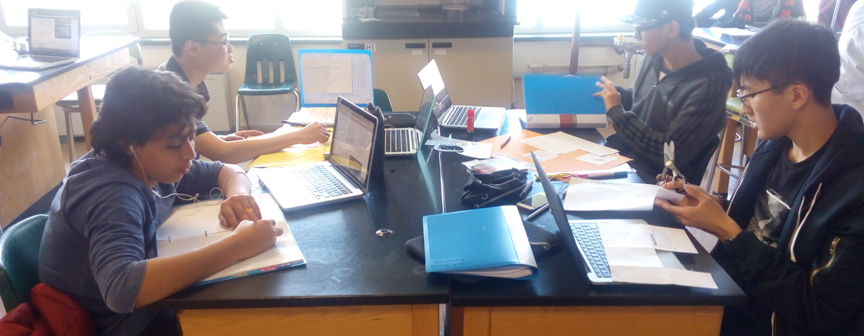
2015-2016 has been an exciting year in the IICS Secondary School science department. Over the past years the science teachers had noticed that student performance in Grade 10, 11 and 12 varied immensely, with high-flying students greedily consuming more knowledge while the course material seemed to run away from those who were struggling. With such a variety of ability levels in any given class, it was becoming extremely challenging and rather impractical for teachers to deliver lessons at an appropriate difficulty level for all students in the class at the same time. A new approach was needed to meet the needs of all students.
With this in mind, the science department began work in early 2015 on developing a modular system of curriculum delivery. Rather than running traditional semester-based science courses, the teachers developed multiple three-week modules, each of which could be studied independently by students. Each module included the basic content and skills that needed to be covered in the unit together with extension work for those who completed the required tasks more quickly. Theoretically, students would be able to take the assessment tasks when they were ready, particularly tests and written assignments, and the teacher would be able to circulate and work with students on an individual basis throughout the lessons. It would also be possible for students who completed modules very quickly to work on other modules (from a different science) in the remaining time, which would allow them to experience units in all three of the main science subjects rather than just taking a semester each of two of them.
The advantages of running the modular system were varied. Students were able to work at their own pace throughout each module; therefore, there were far fewer instances, if any, of students sitting in a classroom not understanding whatever was being delivered by the teacher. Additionally, as students were making choices within each module, it was easier to hold them accountable for the work they were doing, and there were fewer excuses available for poor performance. Finally, as students were flipping between sciences from module to module, by the time they had completed the first semester, they had experienced two modules from two different sciences, and were, therefore, able to make more informed choices for their DP courses at that point.
As with all educational initiatives, however, together with the advantages came challenges. Firstly, the amount of work needed to create the modules so that students could work in a self-directed way was always going to be difficult for the teachers, particularly as the intention was certainly not to have all students working quietly at their computers without any peer interaction. Modules could not just result in the mindless content guzzling that so many online courses seem to become. Secondly, teachers soon realized just how challenging it was mentally and physically to have to be aware of the progress being made by up to fifteen students in a class, all of whom were at different stages of the module. Finally, the self-paced nature of the modules resulted in challenges setting up and running assessments.
These were the challenges that the IICS science team wrestled with throughout their PLC work during the 2015-2016 academic year. Discussions in PLC time together with ongoing reflective practice in the classroom have certainly raised awareness in the science department of the potential benefits and challenges that the delivery of modular learning entails. The key learning points that the team has shared include:
- Modules need to be longer to accommodate all the interruptions in class time that life in a busy Secondary School inevitably results in.
- Students both enjoy and need collaborative work as part of the learning process.
- Generally, students who lack effective study skills are the ones who seem to struggle with modular learning. However, it is keeping them accountable and helping them to develop more independence.
- Generally, students who have done well in this system would probably do well in any system.
- Clear objectives shared at the beginning of the module are imperative to the success of a module.
- Progress checks are an imperative part of a module to make it successful.
Most international school teachers face the daunting challenge of huge differences in academic ability levels and linguistic competence in any given classroom, and the modular approach has the potential to offer a method of curriculum delivery that may alleviate the seemingly impossible requirements of differentiating for such a diverse student body. The IICS science teachers have been taking this challenge head on throughout the year and their learning from this year puts the department in good stead to continue such work in future years. The next steps are likely to involve gathering student feedback on the experience, pushing some modular learning into Grade 9 where appropriate, and sharing the learning with other departments also interested in such an approach.
Meeting the needs of all learners is the challenge that has been set; an effective, carefully considered delivery of thoughtfully designed science modules seems to have a lot of potential to help us meet this challenge.
“You work by yourself but you also get the interaction with the teacher when you need it and you can ask questions…I feel like Grade 7’s might struggle with it because they’re used to working with a teacher. Suddenly changing it to individual studying might be very hard for them.”
– Sophie Krafft, Gr 10 Student


Leave a Reply
Want to join the discussion?Feel free to contribute!